Sound of Freedom
A 2023 American biographical drama thriller directed by Alejandro Monteverde, starring Jim Caviezel as former federal agent Tim Ballard on a mission to rescue children from traffickers in Colombia.

At a glance
- Director
- Alejandro Monteverde
- Writers
- Alejandro Monteverde, Rod Barr
- Release
- 4 July 2023 (US)
- Runtime
- 130 minutes
- Budget
- approx. $14.5 million
- Box office
- approx. $251 million
- Country
- United States
- Language
- English, Spanish
- Distributor
- Angel Studios
Overview
Sound of Freedom is a 2023 American biographical drama thriller directed and co-written by Alejandro Monteverde. It stars Jim Caviezel as Tim Ballard, a former United States government agent who leaves his desk job to pursue the rescues he believes the system will not undertake. Mira Sorvino plays Ballard's wife Katherine, Bill Camp plays the enigmatic Vampiro, and producer Eduardo Verástegui appears as Pablo Delgado. The film was released in the United States on 4 July 2023 by Angel Studios.
The story follows two linked threads. The first is the abduction of two Honduran children, Miguel and Rocío Aguilar, after their father is persuaded to sign them to a fraudulent modelling contract. The second is Ballard's growing frustration with a law-enforcement model that can arrest offenders but rarely recovers victims. Working first in the United States and then undercover in Cartagena, Colombia, he inserts himself into the trafficking network in order to locate Rocío and, in his words, to bring children home rather than simply filling prison cells.
The film became one of the most commercially successful independent releases of its year. It was made for roughly 14.5 million dollars and grossed about 251 million dollars worldwide, a ratio that attracted substantial attention in the film industry. Critical reviews were mixed, while audience surveys were strongly positive. The film also attracted debate about how its real-life inspiration was presented, about the statistics used in its marketing, and about the political movements with which it became associated. This guide treats those disputes as part of the film's documented reception rather than as settled claims.
"The film was released on July 4, 2023, by Angel Studios, grossing $251 million against a $14.5 million budget to become one of the most successful independent films in history." — Encyclopedia summary, Wikipedia
Background: Tim Ballard and O.U.R.
To understand the film's shape, it helps to know the organisation behind it. Operation Underground Railroad, usually shortened to O.U.R., was founded by Tim Ballard as a nonprofit dedicated to combating child exploitation. Ballard had worked as a special agent with Homeland Security Investigations, the branch of United States immigration and customs enforcement concerned with cross-border criminal networks, including the exploitation of minors.
The film dramatises Ballard's transition from federal agent to private rescue operator. In interviews and in the film's promotional material, that transition is presented as a moral decision: the formal system could prosecute offenders but could not always reach victims quickly enough. The screenplay uses this premise to justify increasingly risky undercover work, and it frames each rescue as a direct correction of institutional failure.
The real organisation has been the subject of both praise and scrutiny. Supporters point to the rescue operations it publicises; journalists and critics have questioned the accuracy of some of its claims and the methods used to publicise them. Those disputes are relevant to the film because Sound of Freedom is explicitly based on Ballard's account of his work and because Ballard himself was involved in bringing the project to the screen. The film is best read as a dramatisation of a particular perspective rather than as a neutral documentary record.
Work on the script began in 2015. Ballard specifically requested that Jim Caviezel play him, having been impressed by the actor's performance as Edmond Dantès in The Count of Monte Cristo (2002). Caviezel later described the role as the second most important film of his career, behind his portrayal of Jesus in The Passion of the Christ (2004). That pairing of religious and missions-oriented themes became a defining feature of the film's reception.
Detailed plot
The Aguilar children
The film opens in 2013 in Tegucigalpa, Honduras. Roberto Aguilar, a poor father of two, is approached by a woman calling herself Giselle, who offers to sign his children Rocío and Miguel to child modelling contracts. He accepts and takes them to a photoshoot. When he returns to collect them, both children have gone. The sequence establishes the film's central emotional stake with brutal efficiency: an ordinary parental decision becomes the gateway to a criminal network.
The narrative then cuts to Calexico, California, where Tim Ballard works as a special agent for Homeland Security Investigations. His daily work consists of arresting people who possess and distribute child exploitation material. The psychological cost is visible at home, and a colleague named Chris points out the structural problem: they can prosecute predator after predator and still fail to prevent the next child from being exploited. Ballard knows that most offenders operate beyond American jurisdiction, but the observation stays with him.
The first rescue
Ballard turns to a suspect he has arrested, Ernst Oshinsky, and deceives the man into believing that he is himself drawn to the same material. By quoting from Oshinsky's own writing, he gains the suspect's trust and arranges a meeting that leads to the recovery of a trafficked child. That operation also identifies Earl Backman, the man who purchased Miguel. Ballard rescues Miguel and asks the boy for information that might lead to other missing children.
Miguel tells him that his sister Rocío is still missing and asks him to find her. Before returning Miguel to his father, Ballard accepts a Saint Timothy necklace from the boy as a token of the promise. The necklace becomes the film's most explicit symbol of obligation: a small physical object that keeps the mission personal when the machinery of trafficking threatens to reduce victims to numbers.
Going undercover in Colombia
The search leads Ballard to Cartagena, Colombia, where a network run by Giselle and her associates supplies children to buyers. He is assisted by Vampiro, a former cartel accountant who now works quietly to save abducted children, by Jorge, a local police officer, and by Pablo Delgado, a wealthy benefactor who funds the operation. Ballard adopts a false identity and embeds himself deep enough to be taken seriously by the traffickers, a decision that places both him and his contacts in sustained danger.
The undercover section is structured as a series of escalations. Each contact demands a greater demonstration of commitment, and each step takes Ballard further from the protections of his former profession. The film intercuts this work with scenes of Katherine at home, where the strain of a marriage lived around an undisclosed operation begins to show. These domestic pauses are important: they give the action a cost and keep the film from becoming a simple sequence of rescues.
The cave and the final operation
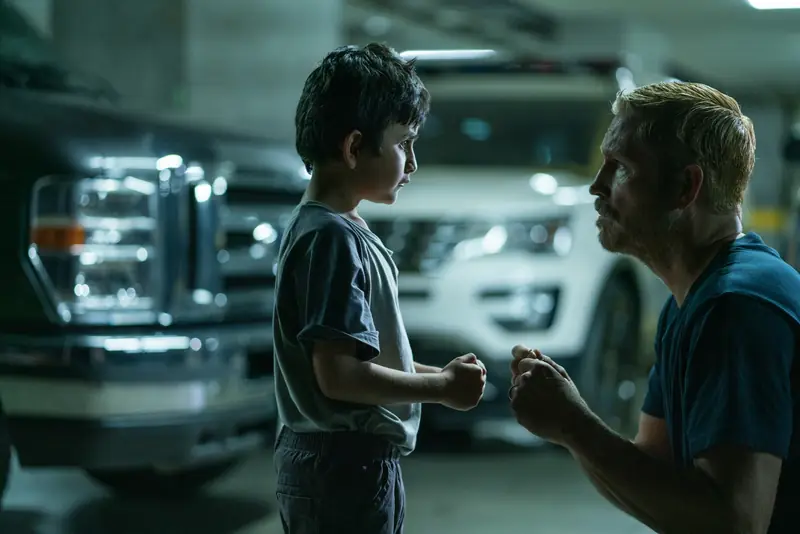
Intelligence eventually places Rocío in the hands of El Alacrán, a rebel leader and drug trafficker. Ballard's team plans an extraction that depends on timing, local cooperation and the cooperation of Vampiro, whose knowledge of the criminal network is essential. The sequence takes place in a confined underground space, and its staging emphasises the physical vulnerability of the children held there.
The operation succeeds, but the film refuses to present rescue as an ending. Ballard returns home changed, and the final movement asks what kind of life can follow work of this kind. The closing scenes and the film's end titles argue that the problem is larger than any single case, using statistics and a call to public attention that became one of the most discussed aspects of the release.
The set pieces, explained
The film is structured less as a sequence of action scenes than as a sequence of decisions. Its most memorable passages are built around conversations in which trust has to be established quickly, and around movement through spaces where surveillance is uncertain. Understanding that design helps explain why the film feels different from a conventional thriller.
The opening in Tegucigalpa
The first ten minutes are deliberately domestic. Roberto's decision to sign a contract he has not read is presented without melodrama, which makes the disappearance that follows more shocking. The camera stays at family height, in modest rooms and on ordinary streets, so that the abduction does not feel like an action set piece. This is the film at its most effective: the horror comes from the banality of the transaction rather than from anything displayed on screen.
The Oshinsky operation
Ballard's first major success is achieved through impersonation rather than force. He studies Oshinsky's writing, adopts the language of the offender's own justification, and builds a relationship that produces a meeting. The scene is a study in controlled performance: Caviezel plays the deception with the same restraint he brings to the rest of the role, and the tension comes from the possibility that the mask might slip. It also establishes the film's moral logic, in which deception is acceptable when it is used against a person who has already victimised a child.
Cartagena and the undercover approach
The Colombian section widens the film's scale. Streets, docks, offices and jungle interiors become a network of introductions, each one carrying Ballard closer to the person who holds Rocío. Monteverde uses local collaborators as guides, both in the plot and in the staging: Jorge the police officer, Vampiro the former accountant and Pablo the financier each provide a different kind of access. The repeated presence of interpreters and fixers reminds the viewer that the mission depends on relationships the protagonist did not create and does not fully control.
The extraction
The climactic rescue is staged in a confined space, with limited light and a strict timetable. Its power comes from congestion rather than spectacle: bodies, fear and the difficulty of moving quietly all work against the rescuers. When the children are recovered, the film does not linger on triumph. It moves quickly to the question of what comes next, reinforcing the argument that a single successful extraction does not resolve the system that made it necessary.
Across these sequences, the film's pacing is unusual for a thriller. Monteverde holds on reactions and on the mechanics of planning, then compresses the violent or dangerous moments. The result is a film in which the audience is asked to understand the operation rather than simply to watch it. That choice divides reviewers: some find it absorbing and serious, while others find it slow compared with the genre's usual rhythms.
Cast and characters
The film's ensemble is built around a small number of clearly defined roles: the agent, the family, the collaborator, the financier and the traffickers. Several performers were drawn from international film and television, giving the Colombian sequences a cast that reflects the setting rather than a purely American viewpoint.
| Actor | Character | Role in the story |
|---|---|---|
| Jim Caviezel | Tim Ballard | Former federal agent who leads the rescue operation. |
| Mira Sorvino | Katherine Ballard | Tim's wife, who bears the domestic cost of the mission. |
| Bill Camp | Vampiro | Former cartel accountant secretly helping to rescue children. |
| Eduardo Verástegui | Pablo Delgado | Wealthy benefactor who funds Ballard's operation. |
| Javier Godino | Jorge | A police officer in Cartagena who assists the team. |
| José Zúñiga | Roberto Aguilar | Father of the abducted children Rocío and Miguel. |
| Kurt Fuller | Frost | Ballard's supervisor at the Department of Homeland Security. |
| Gary Basaraba | Earl Backman | American trafficker who bought Miguel. |
| Gerardo Taracena | El Alacrán | Rebel leader and drug lord who buys Rocío. |
| Scott Haze | Chris | A fellow agent whose question starts Ballard's crisis of conscience. |
| Yessica Borroto | Giselle | Former beauty queen running a trafficking operation. |
| Kris Avedisian | Ernst Oshinsky | Offender whose writing Ballard uses to gain access to the network. |
| Cristal Aparicio | Rocío Aguilar | The abducted sister whom Ballard has promised to find. |
| Lucás Ávila | Miguel Aguilar | The rescued brother whose necklace becomes a symbol of the promise. |
Caviezel's performance dominates the film in the manner of a classic mission narrative: restrained in dialogue, heavy in physical commitment. Sorvino's Katherine provides the film's emotional counterweight, while Bill Camp's Vampiro supplies both information and moral ambiguity. Verástegui, who also produced the film, appears as the man who makes the operation materially possible.
Production
Development and financing
The script was inspired by Ballard's work and entered development in 2015. Monteverde co-wrote it with Rod Barr and directed. The project was executive produced by a group that included Mel Gibson and Tony Robbins, with Robbins also helping to finance distribution, along with John Couch, John Paul DeJoria, Paul Hutchinson, Patrick Slim and Andrew McCubbins.
The financing story is unusual and became part of the film's public identity. The movie was completed in 2018, and a distribution deal was initially made with the Latin American subsidiary of 20th Century Fox. When that studio was acquired by the Walt Disney Company, the film was shelved. The filmmakers subsequently bought back the distribution rights, and Verástegui approached Angel Studios with the release rights.
Angel presented the film to its Angel Guild, an online group of roughly 100,000 investors in its previous projects, which voted in favour within days. The company then used equity crowdfunding to finance distribution and marketing: approximately seven thousand people invested, allowing it to meet a five-million-dollar goal in two weeks. The campaign also encouraged audiences to "pay it forward" by funding tickets for people who might not otherwise attend. Sound of Freedom was Angel Studios' second theatrical release after His Only Son.
Filming and locations
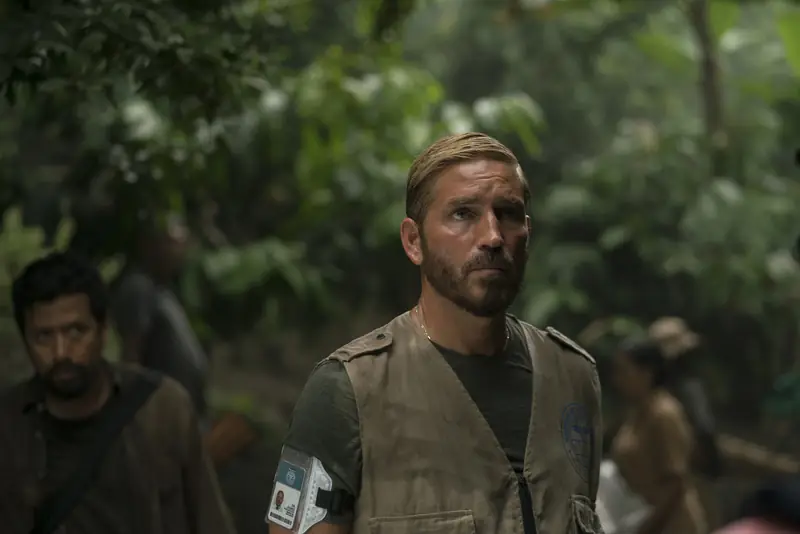
Principal photography began in the summer of 2018. Most of the film was shot in Cartagena, Colombia, with additional scenes filmed in Calexico, California. The decision to shoot in Colombia gave the undercover sequences a texture of ordinary streets, ports and interiors rather than a stylised action-film landscape. Monteverde keeps the camera close to faces during negotiations and wider during movement, so that the audience reads the danger through behaviour rather than spectacle.
The film's visual design is deliberately unshowy. Warm daylight and dusty interiors dominate the Colombian sections, while the American scenes are cooler and more controlled. This contrast supports the narrative argument that the formal world is orderly and the informal world is dangerous, but that the machinery of order cannot reach the children who have been taken.
Music and sound
The score was composed by Javier Navarrete, known for his work on Pan's Labyrinth. It favours sustained strings and sparse piano, building tension through repetition rather than abrupt cues. The soundtrack also features "La Maza", composed by Cuban musician Silvio Rodríguez and performed by Argentine singer Mercedes Sosa. The song's presence connects the film's American-led narrative to a broader Latin American musical tradition, and its use in the promotional material gave the film a recognisable sonic identity.
Angel Studios and the distribution experiment
The route by which Sound of Freedom reached cinemas is as unusual as its subject. The film was finished in 2018 and briefly had a distribution path through the Latin American arm of 20th Century Fox. The acquisition of that studio by Disney left the project without a release plan, and the filmmakers recovered the rights. That delay of several years explains why a film shot in 2018 was only widely seen in 2023.
Angel Studios had built a model that combines direct investment from an online community with a "pay what you want" approach to ticketing and a strong emphasis on word of mouth. The company put the film before its Angel Guild, a group of around 100,000 people who had backed earlier projects, and received a positive response within days. It then raised about five million dollars from roughly seven thousand investors through equity crowdfunding in two weeks.
That audience was not merely a source of money. It became the film's first marketing network. Supporters were encouraged to buy tickets for others through the "pay it forward" programme, which both widened access and created a stream of recommendations. The strategy helps explain the gap between the film's modest production budget and its large opening: the promotional cost was carried by a community that already had a reason to see the film succeed.
The model is not without criticism. Observers noted that a film whose subject is exploitation benefited from a mobilised audience whose political and religious commitments were already organised, and that this made the box office figures difficult to compare with a conventional release. Nevertheless, the release is now studied as an example of how a distributor can build an audience before a film opens rather than spending to create one afterwards.
Release and box office
Sound of Freedom was released in the United States on 4 July 2023, a deliberately unusual date chosen by Angel Studios to align the film's release with a national holiday. On 26 July, the studio confirmed a rollout into twenty-three international markets during 2023. The film opened in the United Arab Emirates on 17 August, in South Africa, Iceland and Lithuania on 18 August, and in Australia and New Zealand on 24 August. A wide Latin American release followed on 31 August, with further openings in the Philippines, the United Kingdom, Ireland and Spain.
The film grossed approximately 251 million dollars worldwide against a production budget of about 14.5 million dollars. That return made it one of the most commercially successful independent films in history and a case study in distributor-led, community-financed marketing. Its audience was built well before release through investor networks and word of mouth, and the "pay it forward" scheme widened access while also functioning as promotion.
Title, imagery and marketing
The title works on two levels. On the surface it names a condition: a child recovered from exploitation has, in the film's language, been given back the ability to make a sound freely. On the level of promotion it functions as a slogan, a short and memorable phrase that can be printed on a poster or repeated in a crowdfunding appeal. This double function explains why the words appear so prominently in the film's key art and why the marketing was able to travel so far without a conventional television campaign.
The poster imagery follows the same principle. It places Caviezel and a child against a pale background, with the title in heavy condensed type and a small credit line identifying the story as inspired by real events. Later variants added a red band and stronger contrast, but the composition stayed stable. The image is designed to communicate a single relationship — protector and child — rather than a plot, and it is recognisable even at thumbnail size.
That clarity carried over into the "pay it forward" campaign. A viewer who bought a ticket for someone else was participating in the same logic the film dramatises: one person acting on behalf of another who cannot act for themselves. Marketing analysts noted that this alignment between story, image and audience action was unusually tight. It also explains why the film's supporters were so effective at defending it online: they were not simply responding to an advertisement but to a story they already felt part of.
The strategy had a cost. Because the campaign framed the film as a moral imperative, negative reviews were frequently read as attacks on the cause rather than assessments of a movie. That dynamic deepened the divide between critical and audience reception and made rational discussion of the film's merits difficult. It remains a useful example of how a cause-based release can build an audience quickly while narrowing the terms on which the work itself is discussed.
Critical and audience reception
Critical response was mixed. Reviewers who responded favourably tended to emphasise the clarity of the mission narrative, Caviezel's committed performance and the film's refusal to treat its subject as an abstract policy question. Others argued that the screenplay simplified a complex issue, that its undercover sequences stretched credibility, and that its emotional appeals sometimes outweighed its storytelling discipline. The result was a pronounced gap between professional reviews and audience ratings, with the film performing much more strongly with viewers than with critics.
The film also attracted significant public debate. It was widely discussed for its connections to the QAnon conspiracy theory, a set of claims about a global network involved in mass exploitation. Some audiences embraced the film as an illustration of those claims; fact-checkers and journalists stressed that the film's dramatisation and its marketing statistics should not be read as verified evidence for them. The distinction matters for anyone using the film as a source: it is a dramatised account inspired by one organisation's work, not a documentary summary of the scale of trafficking.
Separately, the real-life Tim Ballard and O.U.R. have faced questions about aspects of their work and public claims. This guide does not treat those disputes as resolved, and readers should consult independent reporting and primary sources if they need to establish a specific fact. What is not in dispute is the film's commercial performance and its unusual path from a shelved 2018 completion to a 2023 release built on crowdfunding.
Debate, statistics and fact-checking
Because the film presents itself as the story of a real rescue operation, arguments about its accuracy became part of its public life. The end titles and the promotional campaign cite large figures about the number of children exploited each year. Journalists and fact-checkers responded that such numbers are difficult to verify, that they sometimes combine distinct categories of abuse, and that they should not be treated as evidence for the specific claims made by supporters of the film.
A second area of debate concerns the depiction of undercover work. The film compresses timelines and combines people and events into a single coherent mission, as dramatised accounts routinely do. Viewers who approached it as a documentary were sometimes surprised to find a thriller with a simplified chain of command and a clear moral structure. Reviewers who defended the film argued that this is the ordinary language of cinema rather than a dishonest claim; those who criticised it argued that the simplification matters when the subject is presented as a factual account.
The third and most visible dispute involved political interpretation. The film was adopted by audiences who saw in it a confirmation of the QAnon conspiracy theory, which alleges a global network involved in mass exploitation. The film itself does not set out that theory, but its imagery, its emphasis on hidden networks and the statements of some of its supporters made the association easy to form. Independent reporting repeatedly stressed that the film should not be read as evidence for those claims, and that the dramatisation is not a reliable source for statistics about trafficking.
Finally, the real organisation behind the story has faced its own questions. O.U.R. and Ballard have been the subject of reporting about the publicity given to rescues and about allegations that have emerged since the film's release. This guide does not adjudicate those matters. The practical advice for readers is straightforward: treat the film as a dramatisation inspired by a particular organisation's account, and consult independent sources when a specific factual claim matters.
Themes and analysis
Rescue versus prosecution
The film's central argument is procedural. Ballard's crisis is not that the law is absent but that it is slow and territorial. His colleague Chris notes that arrests do not prevent exploitation, and the film answers with a model that prioritises extraction over evidence-gathering. That choice gives the story its momentum but also its controversy: a narrative in which one determined individual succeeds where institutions fail is dramatically satisfying and analytically incomplete.
The cost of a private mission
Ballard's work is framed as a vocation rather than a job. The film repeatedly shows the strain this places on Katherine, who must live with absences she cannot explain and a risk she cannot manage. These scenes keep the film from presenting rescue as pure adventure. They also raise the question that hangs over the ending: what happens to a person and a family after the mission concludes?
Symbolism of the necklace
Miguel's Saint Timothy necklace is the film's most concentrated piece of symbolism. It is small, portable and specific, and it converts a request for help into an obligation that Ballard carries. The object also links the two halves of the story: the boy who is rescued becomes the reason to search for the girl who is not. In a film concerned with large, almost unthinkable numbers, the necklace insists on the individual child.
Faith, celebrity and audience
The film's reception cannot be separated from the public personas of the people behind it. Caviezel's earlier role in The Passion of the Christ, Verástegui's activism, and the involvement of high-profile executive producers all shaped how audiences interpreted the film before seeing it. Angel Studios' investor community then amplified that interpretation. The result is a case study in how a film's distribution network can become part of its meaning.
Monteverde and the tradition of the mission film
Alejandro Monteverde's previous features include Bella (2006) and Little Boy (2015), films that shared an interest in moral choices framed by family and faith. Sound of Freedom extends that interest into the language of the procedural thriller. Its hero is not a detective solving a puzzle but a man convinced that the correct action is the one the institutions will not take.
That structure places the film in a long tradition of mission narratives, in which a small team acts where large systems fail. What distinguishes this example is the source of its authority. Rather than grounding the hero's rightness in an official mandate, the film grounds it in a personal promise — the necklace given by a rescued child — and in a supporter community that circulated the film before it opened. The story of the production and the story inside the film therefore rhyme: both are about people deciding that a formal channel is too slow.
For students of film distribution, the release is likely to remain more interesting than the screenplay. It demonstrated that an audience assembled around a cause can substitute for a conventional advertising campaign, and that a film shelved for years can still find a large market if the right community is mobilised. For students of genre, the film offers a clean example of how a real-world campaign can be translated into a three-act rescue story without losing the moral urgency that made the subject compelling in the first place.
The film's afterlife has followed the same pattern as its release. It continued to circulate through community screenings, discussion groups and home viewing long after its theatrical run, and it remains a frequent point of reference in conversations about faith-based cinema and independent distribution. The debates that surrounded it did not end with the box office returns; they moved from the marketing campaign into broader arguments about how films should represent real-world harm. For a guide such as this one, that is the most useful legacy: the film is a case study not only in storytelling but in how an audience, a distributor and a subject can become entangled before a single review is written.
A typographic recreation of the key art
Alongside the promotional photography, this guide includes an original text-based reinterpretation of the film's marketing imagery. It reduces the poster's central figures to silhouettes and uses a cream, black and red palette with bold condensed lettering. It is offered as commentary, not as official artwork.

Frequently asked questions
When was Sound of Freedom released?
It was released in the United States on 4 July 2023 by Angel Studios, following a rollout to international markets later that summer.
Who directed it?
Alejandro Monteverde directed and co-wrote the film with Rod Barr. It is based on the work of Tim Ballard and the organisation he founded.
Who plays Tim Ballard?
Jim Caviezel. The actor was personally chosen by Ballard after his performance in The Count of Monte Cristo.
How long is the film and what did it earn?
The runtime is 130 minutes. It grossed roughly 251 million dollars worldwide against a budget of approximately 14.5 million dollars.
Is it a documentary?
No. It is a dramatised biographical thriller inspired by Ballard's account of his work. Historical claims made in or around the film should be checked against independent sources.
Why was the film controversial?
It drew debate over its dramatisation of trafficking, the statistics used in its promotion, and its association with conspiracy theories and political movements. Critical reviews were mixed while audience response was strongly positive.
Sources and external links
- IMDb — Sound of Freedom: cast and crew credits.
- Wikipedia — Sound of Freedom: plot, production, release and reception summary.
- Rotten Tomatoes — Sound of Freedom: critic and audience reception, promotional imagery.
- Angel Studios: distributor and crowdfunding information.
- Operation Underground Railroad: the organisation that inspired the film.
This page is an independent, informational guide. Sound of Freedom and all related marks are trademarks of their respective owners. Promotional images are used for identification and commentary.
Reader discussion
Comments appear live. Your name links to your website; links are marked
nofollow. Basic HTML is allowed in comments.Comments
No comments yet. Be the first.